
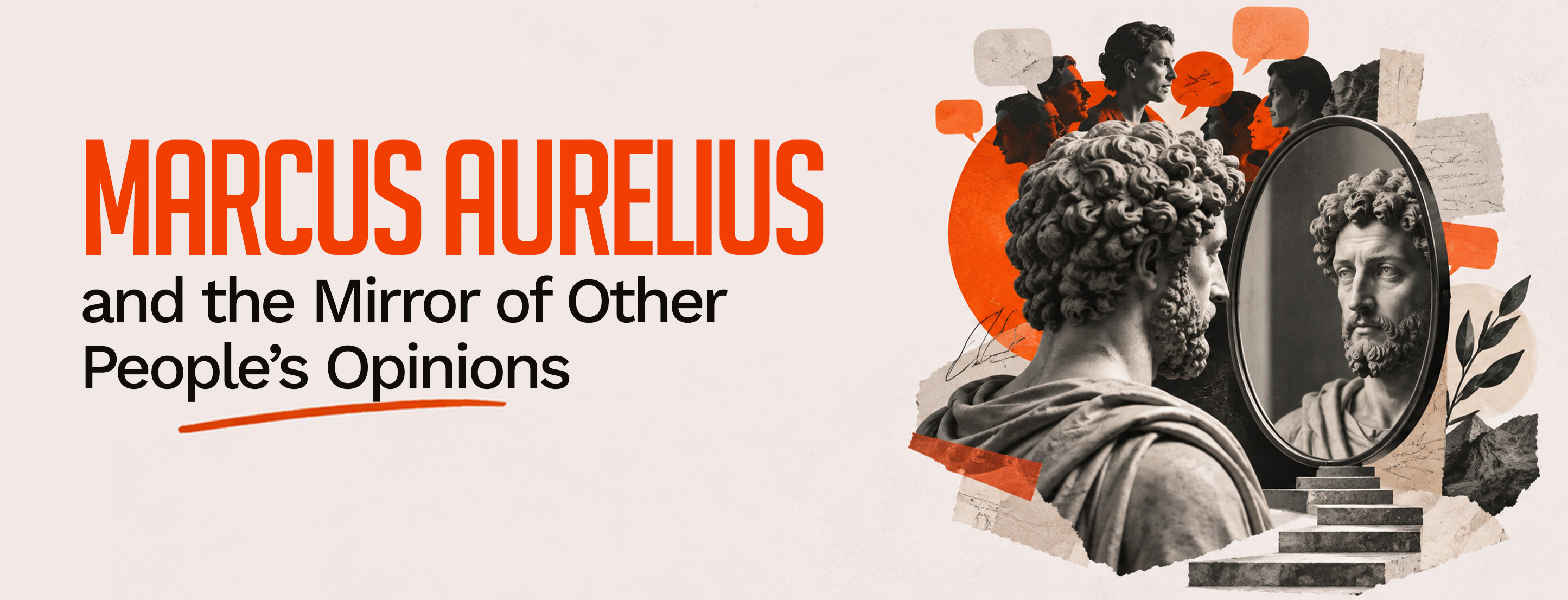


A mirror has one job: to show you a reflection. But what happens when you start believing the reflection is the truth?
We spend much of our lives being seen.
And because we are being seen, we become conscious of how we are perceived. Slowly, the gaze of others can become a second voice inside our own minds: a voice that tells us whether we are enough, capable enough, articulate enough, successful enough. But a reflection is never the whole person.
It is only an image shaped by where the mirror stands.
Marcus Aurelius understood this long before the modern world gave us performance reviews, professional identities, social media, and the constant pressure to be perceived a certain way.
So what happens when we stop asking, “How am I being seen?” and begin asking, “Who am I becoming?”
That question takes us straight into one of the most enduring lessons of Stoic philosophy and into something many of us quietly struggle with at work: how to hear other people's opinions without allowing them to become our definition of ourselves.
Before we borrow wisdom from Marcus Aurelius, it is worth knowing the man behind it.
Marcus Aurelius was a Roman emperor who ruled from 161 to 180 CE and is also remembered as one of the most prominent Stoic philosophers. He lived in a world of power, responsibility, conflict and public scrutiny yet much of what we know of his philosophy comes not from speeches to an audience, but from private reflections he wrote for himself in what is now known as Meditations.
That is perhaps what makes his writing so interesting. He was not writing from a comfortable distance, telling other people how they should live. He was reminding himself how to think.
Again and again, he returned to questions of control, judgment, reputation, character and the opinions of others. And there is something striking about how relevant those reflections remain. Because although our world looks very different from ancient Rome, one thing has barely changed:
We still give other people's opinions enormous power over our inner lives.
Marcus Aurelius challenged that habit from several different angles.
And when we look closely at his reflections, three interesting paradoxes emerge about which we are going to talk in this blog.
Human beings are naturally concerned with themselves. We protect our interests. We care about our future. We defend our choices. We want to feel respected and valued.
Marcus Aurelius observed this tendency in human nature, yet there is an interesting contradiction within it.
We can be fiercely protective of ourselves in almost every area of life and yet become surprisingly willing to surrender our sense of worth to someone else's judgment. Why? Because somewhere along the way, being valued by others can become confused with being valuable.
And the workplace can make that confusion particularly easy.
Professional life comes with titles, reviews, recognition, promotions, feedback and expectations. We are constantly being assessed, formally or informally. But there is a difference between being evaluated for a particular piece of work and being evaluated as a person.
A project may not have gone well. A skill may need improvement. Our communication may need work. Our pace may need to change. All of those things can be legitimate feedback. But none of them has to become a verdict on our entire identity.
This distinction became particularly meaningful to me when I entered a completely new professional environment. There were moments when I felt I was learning slower than the people around me. At one point, being called “slow” stayed in my mind far longer than I would have liked. The comment itself was small.
But the meaning I attached to it was not.
Eventually, I realised I could take the useful part of the feedback without turning the word into an identity. Perhaps I did need to improve my pace. That did not mean I was incapable of improving. And that is an important distinction in professional growth:
A weakness is something you can work on. It does not have to become a definition of who you are.
Here is another strange thing about opinions. An opinion exists inside another person's mind. It is their interpretation of you. Yet we can allow that interpretation to occupy our own minds for hours, days, sometimes much longer.
Marcus Aurelius repeatedly reminded himself about the temporary nature of reputation, praise and criticism. People change. Opinions change. Circumstances change. And yet we often treat a passing judgment as though it were a permanent truth.
Someone's opinion becomes a sentence. Then the sentence becomes a belief. Then the belief becomes part of our identity. That is how external validation slowly gains power.
The problem is not that people have opinions about us. The problem is when we start using those opinions as our primary measurement of ourselves.
At work, this can become particularly exhausting. If appreciation makes us feel competent, criticism can make us feel incompetent. If recognition makes us feel visible, being overlooked can make us feel insignificant. If someone's approval gives us confidence, their disapproval can take it away. Our sense of self begins moving according to everyone else's reactions.
Marcus Aurelius offers a powerful counterpoint: other people's thoughts are outside our control. We cannot manage every opinion. We cannot correct every misunderstanding. We cannot make everyone see our intentions accurately.
So perhaps the better question is not: “How do I make everyone think well of me?” But “How much of my mental energy should I give to something I cannot control?”
That question alone can change how we experience the workplace.
If other people's opinions cannot be the foundation of our self-worth, what should replace them?
For Marcus Aurelius, the answer was not simply confidence or positive thinking. It was character and conduct.
Instead of constantly asking whether other people approved of him, the Stoic approach was to examine whether he himself was acting according to reason, virtue and responsibility. That idea translates beautifully into professional life.
Instead of asking: Do they think I am capable?
we can ask: Am I becoming more capable?
Instead of: Do they respect me?
we can ask: Am I behaving in a way that deserves my own respect?
Instead of: Did they notice my contribution?
we can ask: Did I contribute meaningfully?
And instead of: What do they think of me?
Perhaps the deeper question is: What do I think of the way I am showing up?
This does not mean ignoring feedback. Quite the opposite.
It means having enough inner grounding to listen without immediately surrendering your judgment.
Perhaps this is where Marcus Aurelius becomes especially relevant to professional growth.
A workplace is full of mirrors. Some reflect genuine feedback; others reflect expectations, preferences, assumptions, or simply another person's way of seeing things.
The challenge is not to stop looking into those mirrors. It is to understand what they are actually showing us.
There will be things we need to improve. There will be moments when someone else's perspective reveals a blind spot we could not see ourselves. And there will also be opinions that tell us more about the person giving them than about the person receiving them.
Professional maturity lies somewhere between the two. It is the ability to listen without surrendering our self-awareness, accept feedback without turning it into self-judgment, and remain open to growth without becoming dependent on approval.
Perhaps that is a quieter kind of confidence and not the certainty that we are always right, but the ability to examine ourselves honestly without allowing every external judgment to rewrite who we are.
A mirror can help us see ourselves more clearly. It should never become the authority on who we are.
Perhaps the lesson Marcus Aurelius leaves us with is not that we should stop caring about what people think. That would be unrealistic.
We are human. We notice how we are perceived. We value appreciation. We feel criticism. And sometimes, other people's opinions genuinely help us see what we cannot see on our own.
The real question is how much authority we give those opinions over the way we see ourselves.
We can listen without absorbing everything. We can accept criticism without turning it into self-doubt. We can learn from someone else's perspective without making it our identity. And we can continue to grow without needing every person around us to validate that growth.
Perhaps that is what it means to look into the mirror without getting lost in it. Let other people's opinions make you reflect, not define you. Because at the end of the day, your professional growth is not measured only by how others see you. It is also measured by how honestly you look at yourself, how willing you are to learn, and whether you keep becoming better without losing who you are.
Marcus Aurelius had a reminder for himself nearly two thousand years ago. Perhaps it is one worth carrying into the modern workplace too: Listen to the world. Learn from it. But don't let the world become the only mirror through which you see yourself.
And maybe that's the real difference between seeking validation and seeking growth.l

Currently working as a QA Intern at MIDCAI, I’m learning the ropes of software testing, understanding project workflows, and growing through hands-on experience in a fast-paced environment. Beyond tech, I’m deeply interested in writing, workplace dynamics, and exploring the realities of office culture through observations and conversations.
Get in touch with us for any enquiries and questions
Define your goals and identify areas where technology can add value to your business
We are looking for passionate people to join us on our mission.
where your skills fuel innovation and your growth powers ours


.jpg)