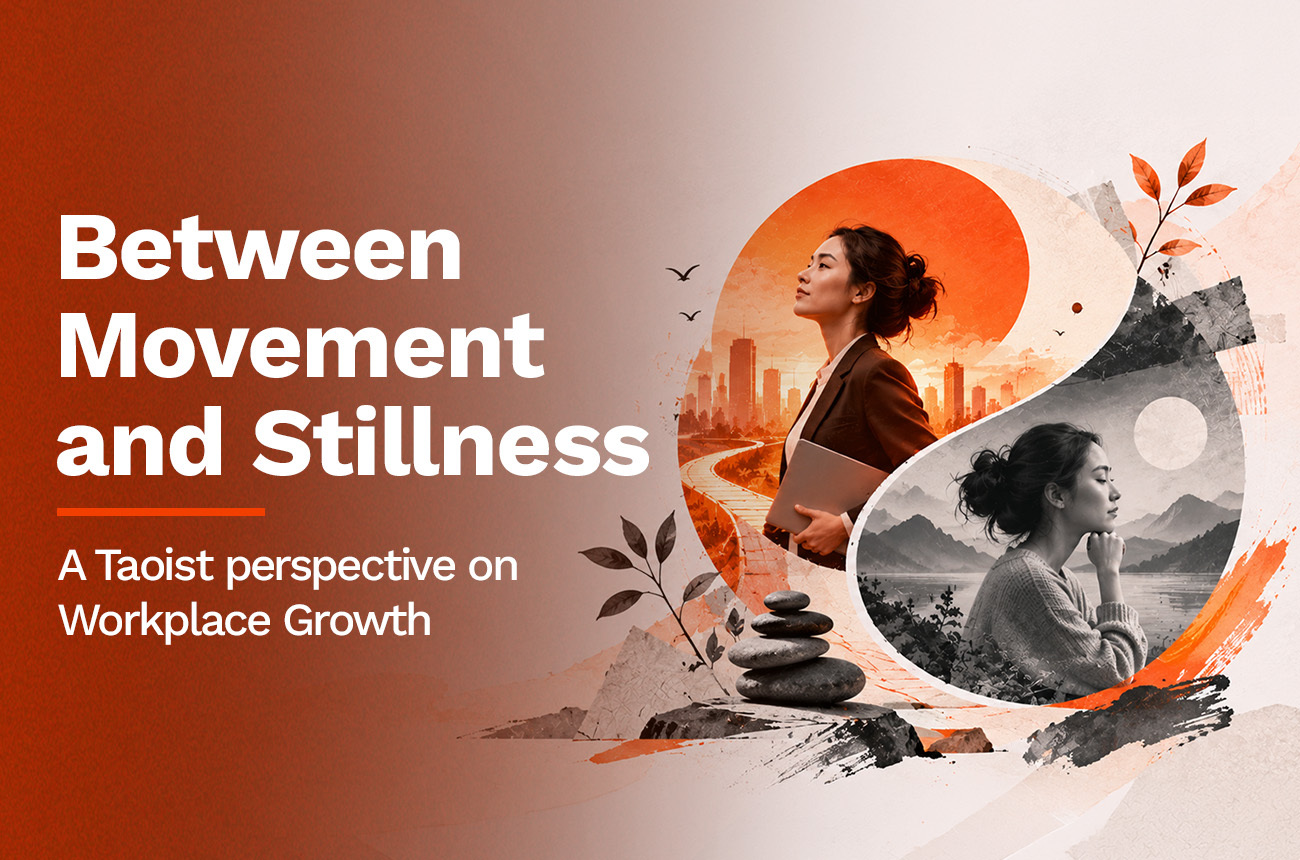


We often associate growth with change.
A new role. A better designation. A promotion. A new workplace. More responsibilities, greater recognition, and a salary that reflects how far we have come.
Somewhere along the way, we begin to believe that if our circumstances remain the same, we must be standing still.
But what if growth isn't always about changing what we do? What if, sometimes, it is about changing how we do it?
Imagine two people performing the same task. Both have the same responsibilities, work under the same conditions, and face the same challenges. One approaches the work with frustration, constantly waiting for something better to happen. The other approaches it with awareness, curiosity, and a willingness to learn.
Their circumstances are identical. Yet their experiences are entirely different. This brings us to a fascinating teaching from Zen Buddhism: Ordinary Mind Is the Way.
It invites us to reconsider our understanding of growth, not just as a movement towards something new, but as a transformation in how we experience what is already in front of us.
And perhaps this is a conversation worth having in our workplaces, where we are so often encouraged to focus on the next milestone that we forget to notice who we are becoming along the way.
In ninth-century China, a Zen monk named Zhaozhou Congshen approached his teacher, Nanquan Puyuan, with a question that seemed simple enough:
“What is the Way?” (In Zen Buddhism, the Way translates the Chinese term Dao (also written Tao), referring here to the fundamental path or reality of spiritual understanding and practice)
He was not asking for directions to a physical destination. He was asking about the Way in the Zen Buddhist sense: a deeper understanding of reality and how one lives in accordance with it.
Nanquan's answer was unexpected.
“Ordinary mind is the Way.”
It was a short response to a question that could have invited a long philosophical explanation. Naturally, Zhaozhou wanted to understand what his teacher meant.
“Should I try to seek it?” he asked.
Nanquan replied that the moment he deliberately tried to pursue the Way, he would move away from it.
This only raised another question in Zhaozhou's mind. If he did not actively seek the Way, how would he recognise it? How could he understand something without making an effort to find it?
Nanquan explained that the Way did not belong to knowing or not knowing. Merely accumulating knowledge was not the same as understanding, while simply remaining unaware was not the answer either. He described the Way as vast and boundless, beyond the ordinary habit of dividing everything into right and wrong.
According to the traditional account, Zhaozhou experienced a sudden awakening upon hearing these words.
The exchange was later preserved as Case 19 in The Gateless Gate, a collection of Zen teaching stories compiled by the Chinese Zen master Wumen Huikai in the thirteenth century.
Although the dialogue is traditionally associated with Nanquan and Zhaozhou, the phrase “Ordinary Mind Is the Way” also belongs to a wider history of Chan Buddhist teaching. It is therefore best understood as a traditional Zen teaching rather than a philosophy invented by one person at a single moment.
But what makes this conversation so intriguing is the question at its centre.
What if the thing we are constantly trying to reach is not somewhere else?
We often imagine that understanding, fulfilment, or a sense of accomplishment will arrive after we have done enough, achieved enough, or become enough. We treat the present as a temporary stage, something to move through before we finally arrive at the life we want.
The teaching challenges that instinct.
An ordinary mind, in this context, does not mean a mediocre mind or one that has stopped questioning, learning, or growing. Nor does it suggest that we should abandon our goals. It points towards a way of experiencing life without constantly getting caught in the pursuit of some imagined state of perfection.
Think about how easily we overlook an ordinary day because we are waiting for an extraordinary one. We finish one responsibility while thinking about the next. We achieve something we once wanted, only to move the goalpost. We keep telling ourselves that things will feel different when we reach the next milestone.
And somewhere in that pursuit, the experience of the present becomes secondary to the promise of the future.
Perhaps the deeper invitation of this Zen teaching is to pay attention to the life we are already living, rather than assuming that its value begins only when something changes.
This does not mean that every circumstance is acceptable or that change is unnecessary. It means that the ability to understand, learn, and grow is not reserved exclusively for the moment when our external circumstances finally improve.
And when we bring this idea into the workplace, a new question emerges:
What if professional growth is not only about changing our work, but also about changing the way we experience it?
Modern workplace culture often measures growth through visible outcomes. I can back this thought as I have often been called slow because my outcomes were not visible at times. And at the same time, I am praised when I do something that is entirely visible in terms of the results.
We look at promotions, performance ratings, targets achieved, projects delivered, and recognition received. These are legitimate measures of professional progress, and they matter. But they do not tell us the whole story.
They cannot always capture the patience we develop while solving a difficult problem, the humility we acquire after making a mistake, the clarity with which we learn to communicate, or the ability to remain thoughtful when a situation becomes uncomfortable.
These changes may not immediately alter our designation or appear on a performance dashboard. Yet they can fundamentally change the way we work.
Consider someone who has been performing the same role for several years. At first, the work may be about learning procedures, meeting expectations, and proving competence. With experience, the person may become more efficient. But genuine professional maturity asks for something beyond efficiency.
Can they recognise patterns that they once overlooked? Can they listen to a colleague without immediately becoming defensive? Can they receive feedback without interpreting it as a personal failure? Can they identify a better way of working instead of repeating a process simply because it is familiar?
The responsibilities may remain the same, but the person's relationship with those responsibilities has evolved.
This is one way to interpret Ordinary Mind Is the Way in a professional context.
Growth does not always announce itself through a change in circumstances. Sometimes, it appears in the quality of attention we bring to familiar circumstances.
There is a difference between doing something because it is assigned to us and understanding the purpose behind it.
When we work mechanically, our attention is often limited to finishing the task. We want to get it out of the way and move on.
But when we become genuinely engaged with our work, even routine responsibilities can become opportunities to notice, question, and improve.
A familiar process may reveal an inefficiency. A recurring problem may help us identify a pattern. A routine conversation may teach us something about communication that we had not previously considered.
The task itself has not changed. Our attention has.
Recognition is a natural human desire. Most of us want our efforts to be acknowledged, and there is nothing wrong with that.
The difficulty begins when external validation becomes the only way we measure our worth.
When every task becomes an opportunity to prove ourselves, feedback can feel threatening, mistakes can become embarrassing, and someone else's success can feel like evidence of our own inadequacy.
A more grounded approach to growth allows us to value recognition without becoming entirely dependent on it.
We can do good work because we care about its quality. We can learn from criticism without allowing it to define us. We can appreciate another person's achievements without turning them into a comparison.
Our work then becomes more than a continuous performance for approval. It becomes a space in which we develop competence, judgement, and self-awareness.
Workplaces are full of moments that test us.
A project does not go as planned. A colleague disagrees with us. A manager points out a mistake. An opportunity we expected goes to someone else.
Our first reaction may be frustration, defensiveness, disappointment, or self-doubt.
Professional maturity does not require us to stop experiencing these emotions. It asks us to become more aware of them.
Instead of allowing every uncomfortable feeling to dictate our next action, we can pause, examine the situation, and choose a response that serves the problem rather than merely expressing our immediate reaction.
That small space between feeling and responding can change the quality of our professional relationships.
And often, this kind of growth is far less visible than a promotion, yet far more influential in shaping the professional we become.
There is a subtle trap in the way we think about professional development.
We tell ourselves that we will become more confident when we get the next role, more fulfilled when we receive recognition, more capable when we lead a bigger team, or more satisfied when we finally reach the position we have been working towards.
We place our growth on the other side of an achievement.
But every new milestone brings its own responsibilities, uncertainties, and expectations. The role changes, the challenges evolve, and another destination begins to appear on the horizon.
If we believe that growth can happen only when our external circumstances change, we may spend years overlooking the opportunities for growth already present in our everyday work.
Imagine two employees who have spent five years in the same role.
One believes those five years represent stagnation because the designation has not changed. The other has used those years to develop deeper expertise, become more thoughtful in decision-making, understand people better, and learn to handle difficult situations with greater composure.
Neither person's professional journey can be understood through designation alone.
Of course, the second employee may still deserve a promotion, better compensation, or new opportunities. Inner growth should never become an excuse for organisations to deny people fair recognition or advancement.
That distinction matters.
The point is not that we should stop wanting better circumstances. It is that we do not have to postpone every form of growth until those circumstances arrive.
We can pursue a better role while becoming better at the role we have. We can aspire to lead others while learning to listen more carefully today. We can seek greater responsibility while developing the judgement needed to handle it.
And we can recognise when our present environment no longer offers the opportunities we need, rather than confusing acceptance with staying somewhere that is harmful or limiting.
Perhaps the real question is not simply, “How long have I been doing this work?”
Perhaps it is also, “What has this work taught me about myself?”
Have I become more patient, or merely more accustomed to frustration? Have I become more capable, or simply more efficient at repeating familiar routines? Have I learned to work with people who think differently from me? Can I acknowledge what I do not know without feeling diminished by it?
These questions shift our attention from time spent to growth experienced.
They also change how we think about workplace culture.
An organisation that values only visible outcomes may overlook the quieter development of its people. A healthier culture creates space for reflection, learning, thoughtful feedback, experimentation, and the recognition that competence is not built through promotions alone.
It understands that employees need opportunities to grow, not merely encouragement to tolerate the same responsibilities indefinitely.
Because the lesson is not that the work must remain the same forever.
It is that we can grow while doing it.
We cannot build our professional lives around the hope that everything will eventually become different.
There will always be another task to complete, another challenge to solve, another skill to develop, and another uncertainty to navigate.
That is not necessarily a failure of progress. It is simply part of working and living.
The teaching Ordinary Mind Is the Way invites us to reconsider where we look for growth. Instead of seeing the present only as a temporary stage before something better arrives, we can begin to recognise it as a place where learning, awareness, and transformation are already possible.
We can remain ambitious without being perpetually dissatisfied. We can seek advancement without dismissing the value of our current experience. We can acknowledge our limitations without making them our identity.
And we can understand that professional growth is not measured only by how far we have moved, but also by how our understanding, judgement, and relationship with our work have evolved.
The next promotion may change our designation. A new role may change our responsibilities. A different organisation may change our surroundings.
But none of these changes automatically guarantees that we will become more aware, more thoughtful, or more fulfilled.
Those transformations require something different: a willingness to pay attention to the person we are becoming in the midst of our everyday lives.
Perhaps that is the quiet wisdom of this Zen teaching.
The work may stay the same for a while. Our circumstances may take time to change. The recognition we hope for may not arrive when we expect it to.
But we do not have to wait for life to look different before we begin to grow.
Sometimes, the most meaningful professional transformation begins when we stop treating the present as merely a stepping stone to the future and start paying attention to what it is teaching us today.

Currently working as a QA Intern at MIDCAI, I’m learning the ropes of software testing, understanding project workflows, and growing through hands-on experience in a fast-paced environment. Beyond tech, I’m deeply interested in writing, workplace dynamics, and exploring the realities of office culture through observations and conversations.
Get in touch with us for any enquiries and questions
Define your goals and identify areas where technology can add value to your business
We are looking for passionate people to join us on our mission.
where your skills fuel innovation and your growth powers ours