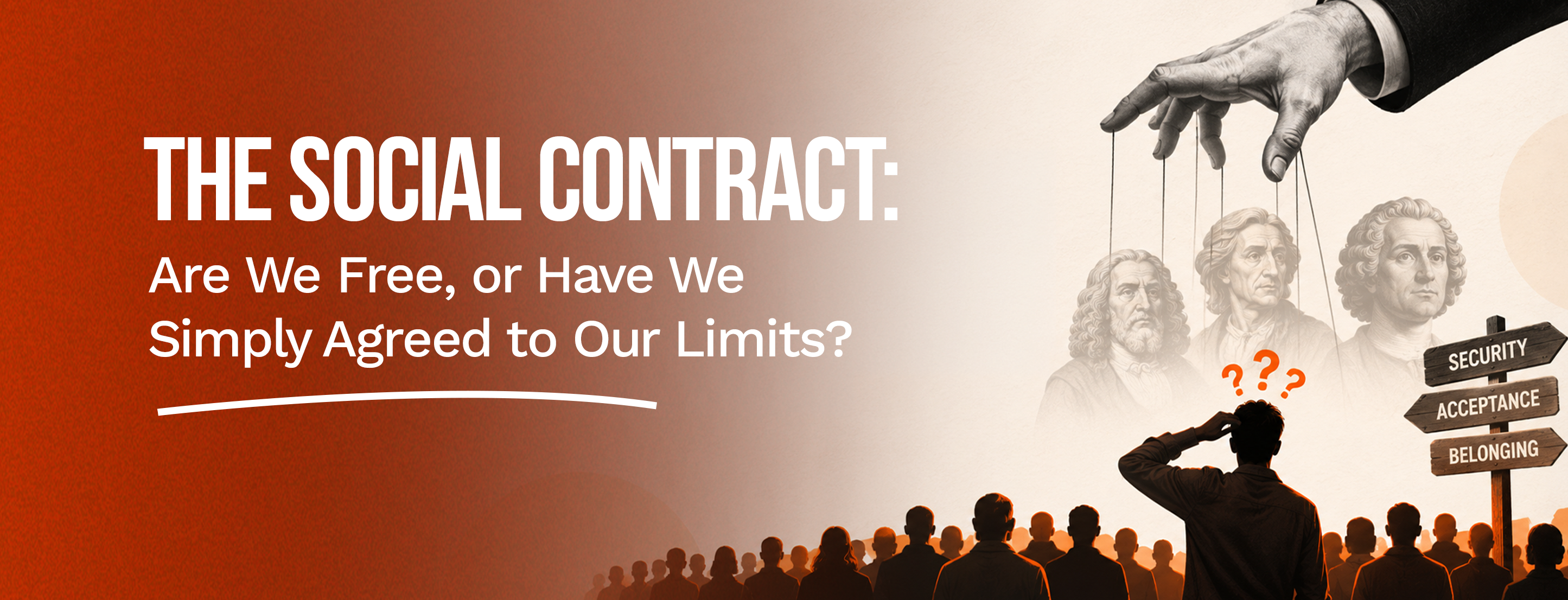


We often think of freedom as the ability to make our own choices, express our opinions, and live life on our own terms. Yet, much of our everyday behaviour is shaped by rules and expectations that we rarely stop to question.
We follow traffic rules, respect social conventions, accept organisational policies, and adjust our behaviour to coexist with others. We give up certain freedoms because we believe the exchange offers something valuable in return: security, stability, acceptance, and a sense of belonging.
But have we ever stopped to think about what we are actually giving up in this exchange?
At what point does cooperation become conformity? When does respecting authority turn into unquestioning obedience? And how do we know whether the limitations we accept are necessary for collective well-being or simply restrictions we have learned to live with?
These questions lie at the heart of the Social Contract Theory, a philosophical idea that examines the relationship between individual freedom, authority, and collective responsibility.
The idea of a social contract became particularly influential during the seventeenth and eighteenth centuries, when philosophers began questioning the foundations of political authority. They wanted to understand why people obey governments, what gives authority its legitimacy, and how individuals can live together without constantly being in conflict.
Three philosophers made particularly important contributions to this discussion: Thomas Hobbes, John Locke, and Jean-Jacques Rousseau. Although they explored the same fundamental relationship between individuals and society, their conclusions were quite different.
Thomas Hobbes, an English philosopher, developed his ideas during a period of political instability and civil conflict in England. Having witnessed the consequences of political disorder, he became deeply concerned with the need for peace and security.
In his famous work Leviathan (1651), Hobbes imagined what human life might look like without a common authority to establish and enforce rules.
He described this condition as the state of nature, where there would be no established government or common power to maintain order. In such circumstances, individuals would have to constantly worry about their safety and survival.
Hobbes believed that people would eventually recognise the need to surrender some of their individual freedom to a powerful common authority in exchange for protection and peace.
His argument was relatively straightforward: without security, freedom itself becomes difficult to enjoy.
However, this raises an interesting question. If we give authority the power to maintain order, how much control should we allow it to exercise over our lives?
John Locke approached the social contract from a different perspective.
Unlike Hobbes, Locke did not consider the state of nature necessarily violent or chaotic. He believed that individuals were naturally free and equal, possessing fundamental rights, including the rights to life, liberty, and property.
In his work Two Treatises of Government, Locke argued that people establish governments to protect these rights more effectively.
For him, the Government was not supposed to own people's freedom. Its authority came from the consent of the governed, and it had a responsibility to serve them. If a government consistently violated the rights it was meant to protect, people had the right to resist and establish a new government.
Locke introduced an important distinction: accepting authority does not mean surrendering all our rights to it.
But this leaves us with another question. Can we truly call an arrangement fair if one side has the authority to make decisions while the other has no meaningful opportunity to question them?
Jean-Jacques Rousseau took the discussion in another direction.
In The Social Contract (1762), Rousseau explored how individuals could form a society without losing their freedom in the process.
He believed that legitimate political authority should be based on the collective interest, which he described through the concept of the general will. According to Rousseau, people should not simply obey the personal wishes of a ruler or a powerful group. Instead, legitimate laws should reflect the common good of the community.
He introduced an interesting idea: freedom does not necessarily mean doing whatever we want. It can also mean participating in creating the rules under which we live.
In other words, when people collectively shape the rules they follow, obedience to those rules need not mean submission to someone else's will.
His philosophy brings us to a thought-provoking question: Can we be part of a collective without losing our individuality?
Although these philosophers were primarily concerned with society, government, and political authority, their ideas offer an interesting way to examine our professional lives.
Every time we join an organisation, we enter an arrangement that involves certain expectations from both sides.
We agree to follow organisational policies, respect reporting structures, meet deadlines, collaborate with colleagues, and take responsibility for our work. In return, we expect fair compensation, professional respect, opportunities to learn, and an environment where our contributions are valued.
Neither side gets everything it wants. Both make compromises to make the arrangement work.
Consider a simple example.
An employee may prefer working independently, but their role requires regular collaboration. They adjust their working style because coordination helps the team achieve its goals. This is a reasonable compromise.
Similarly, an organisation may introduce processes, reporting structures, and accountability measures to ensure that everyone works towards a common objective.
This reflects Hobbes's emphasis on order and stability.
But what happens when an employee is expected to agree with every decision, avoid questioning authority, or sacrifice personal boundaries simply to demonstrate commitment?
This is where Locke's ideas about individual rights and limitations on authority become relevant.
And what happens when employees gradually stop expressing different opinions because fitting in becomes more important than contributing honestly?
This brings us closer to Rousseau's concerns about collective participation and the difference between shared responsibility and simply following others.
The three perspectives help us understand that a workplace needs structure and cooperation, but these should not come at the cost of fairness, individual judgement, or meaningful participation.
One of the most interesting aspects of the social contract is that we do not always surrender our freedom because someone explicitly asks us to.
Sometimes, we do it ourselves.
We accept additional responsibilities because we want recognition. We remain silent during meetings because we do not want to appear difficult. We avoid questioning decisions because we fear how others might perceive us.
Gradually, the desire to be accepted can influence how much of our individuality we are willing to express.
There is nothing wrong with adapting to a professional environment. Learning to collaborate, accepting feedback, respecting differences, and adjusting our expectations are essential parts of professional growth.
However, there is a difference between adapting and constantly suppressing our own judgement.
For instance, disagreeing with a manager does not automatically make someone uncooperative. Similarly, asking for reasonable boundaries does not necessarily indicate a lack of commitment.
A healthy professional relationship should allow room for discussion, disagreement, and mutual accountability.
The real problem begins when maintaining harmony becomes more important than addressing what is wrong.
We may continue following certain expectations simply because they have always existed, without questioning whether they still serve a meaningful purpose.
And perhaps that is when we need to revisit the invisible contract we have accepted.
Does this mean we should resist every restriction or refuse to compromise? Certainly not.
A society cannot function if everyone insists on exercising complete individual freedom without considering others. Similarly, a workplace cannot operate effectively if employees reject every shared process or organisational expectation.
The challenge is not to avoid compromise altogether, but to recognise when a compromise stops being reasonable.
Perhaps we can begin by asking ourselves a few questions.
Does this expectation serve a genuine purpose, or does it simply reinforce someone's authority?
Is the compromise mutual, or is one side constantly expected to adjust? Can we question a decision without being treated as disloyal or difficult?
And most importantly, are we adapting our preferences to work better with others, or gradually abandoning the values and individuality that define us?
These questions do not suggest that every uncomfortable situation is unfair. Professional life will always involve difficult decisions, competing priorities, and occasional sacrifices.
But understanding the difference between a necessary compromise and an unhealthy expectation is an important part of personal and professional maturity.
Growth does not require us to agree with everything. Sometimes, it requires us to understand why we disagree and find a constructive way to express it.
The Social Contract Theory reminds us that individual freedom and collective responsibility are not necessarily opposing forces. In many ways, they depend on each other.
We need shared rules to coexist, but those rules need to serve the people who agree to follow them. We need authority to establish order, but authority also needs accountability. We need belonging, but belonging should not require us to abandon our ability to think independently.
The same applies to our professional lives.
Being a good employee does not mean agreeing with every decision. Being a good team player does not mean saying yes to every expectation. And being committed to an organisation does not mean placing its interests above every personal boundary.
Perhaps true professional maturity lies in understanding when to adjust, when to cooperate, and when to respectfully question what we have been asked to accept.
After all, the purpose of a social contract should not be to make individuals forget their freedom, but to create an environment where everyone's freedom can coexist.
And maybe the question we should occasionally ask ourselves is not simply whether we are following the rules, but whether we still understand why we agreed to them in the first place.

Currently working as a QA Intern at MIDCAI, I’m learning the ropes of software testing, understanding project workflows, and growing through hands-on experience in a fast-paced environment. Beyond tech, I’m deeply interested in writing, workplace dynamics, and exploring the realities of office culture through observations and conversations.
Get in touch with us for any enquiries and questions
Define your goals and identify areas where technology can add value to your business
We are looking for passionate people to join us on our mission.
where your skills fuel innovation and your growth powers ours