
"No man ever steps in the same river twice, for it's not the same river and he's not the same man."
— Heraclitus
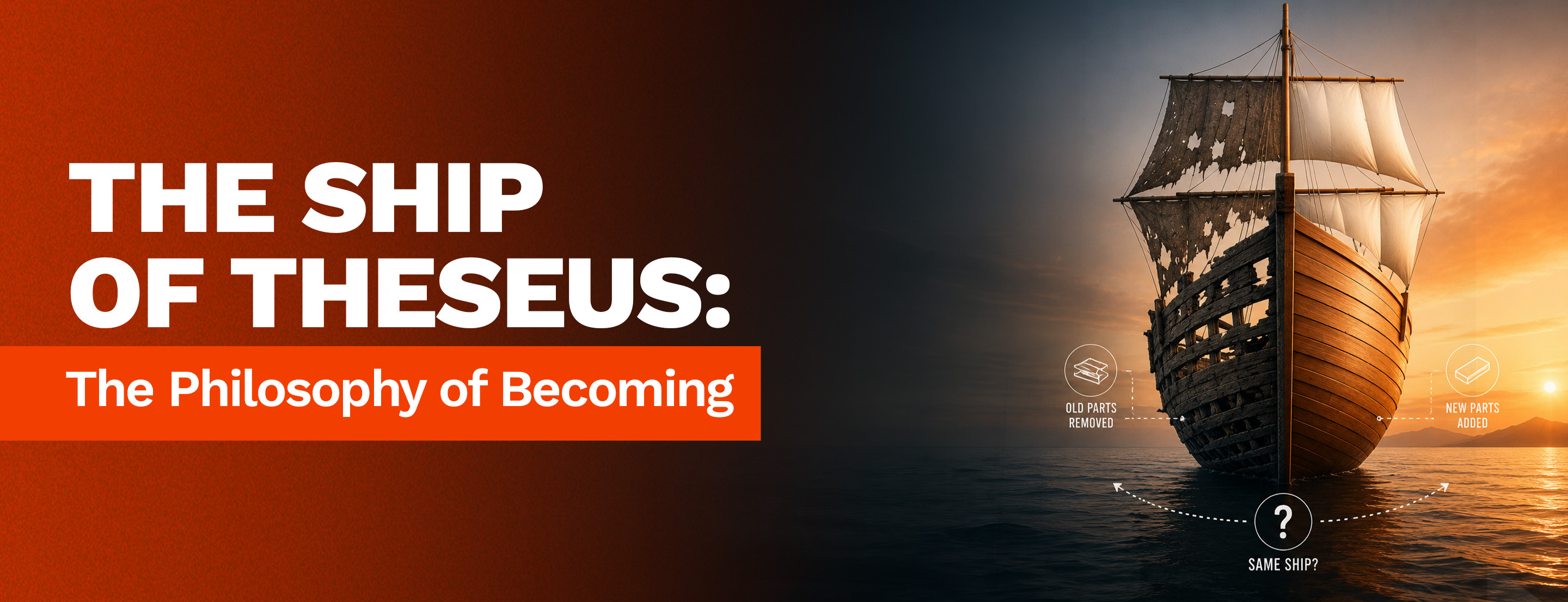
Imagine a ship. Every few years, one weathered plank is replaced. Then another. A damaged sail gives way to a new one. The mast is rebuilt. The deck is repaired. The hull is reinforced.
Years pass. Eventually, not a single original piece remains. Yet, everyone still calls it by the same name. So, here's the question that has fascinated philosophers for over two thousand years: Is it still the same ship?
This thought experiment, known as The Ship of Theseus, isn't really about a ship.
It's about us.
There comes a point in life when you look at an old photograph and struggle to recognize the person staring back. Not because they look different. But because they think differently.
The dreams that once kept them awake no longer matter. The fears that once felt overwhelming seem strangely small. The opinions they defended have softened. The confidence they lacked has quietly grown. Even the definition of success has changed.
If someone could place your eighteen-year-old self beside you today, you might share the same name, the same memories, perhaps even the same smile. But would you truly be the same person?
Perhaps not.
And perhaps that's exactly how it should be.
We often speak about "finding ourselves," as though somewhere in the world there is a finished version of us waiting to be discovered. That literally sounded funny in my head but isn’t it true?
But life rarely works that way. You don't wake up one morning and suddenly become confident. You don't become resilient because you read about resilience. You don't become wise simply because you've grown older. You become these things one experience at a time.
One difficult conversation. One failure. One unexpected opportunity. One heartbreak. One mistake you promised never to repeat. One act of courage when fear would have been easier.
Every experience removes an old plank and replaces it with a new one. Without realizing it, we spend our entire lives rebuilding ourselves.
Centuries after Greek philosophers debated the Ship of Theseus, neuroscience began revealing something remarkable.
Our brains are not fixed. Through a process known as neuroplasticity, our neural connections continuously reorganize as we learn, practice, fail, adapt, and grow. New experiences literally reshape the pathways through which we think and respond.
Psychology echoes a similar truth.
Carl Jung believed that becoming who we truly are is not about pretending to be someone else, but about integrating our experiences and growing into a more complete version of ourselves.
Even our habits reshape our identity. Each decision we repeat strengthens a version of who we are becoming. The ancient philosophers asked a question. Modern science keeps uncovering just how profound it was.
We often believe our jobs are changing our careers. In reality, they are changing us.
Think about your first day in a new role. You hesitated before asking questions. You rehearsed every sentence before speaking in meetings. You worried about making mistakes. You measured your worth by how much you already knew.
Months or years later, something changes. You begin answering questions instead of asking all of them. You mentor someone who reminds you of your younger self. You navigate uncertainty with a little more calm. You realise confidence didn't arrive one Monday morning.
It was assembled. Meeting by meeting. Project by project. Failure by failure. Feedback by feedback.
The projects you completed eventually became less important than the person they quietly built. The workplace isn't merely where work happens. It's where identities evolve.
Not everything deserves to be preserved simply because it has been a part of us for a long time. Some beliefs were inherited before they were ever questioned. Some fears were born from moments that no longer define us. Some habits once protected us but now quietly imprison us.
And some definitions of success were borrowed from a world that never paused to ask what we truly wanted. The difficult part about change is that it rarely asks us to let go of what is bad. More often, it asks us to let go of what has become familiar.
There is comfort in remaining the person we've always been. Familiarity gives us the illusion of certainty, even when it keeps us from growing. We cling to old narratives because they've accompanied us for years: I'm not good enough. I'm not a leader. I always overthink. I'm just not that kind of person.
Over time, these stories stop feeling like opinions. They begin to feel like an identity. But identity should never become a prison built from yesterday's experiences. We often fear change because we mistake familiarity for authenticity. We assume that if a part of us has existed for years, it must be an essential part of who we are.
It isn't.
Sometimes it's simply a version of ourselves that has outlived its purpose. Holding on to an outdated version of yourself isn't loyalty to your past. It's resistance to your future.
Growth doesn't ask us to erase our history or deny the person we once were. Every version of us deserves gratitude because each carried us to the next chapter. But gratitude doesn't require permanence.
Just as the Ship of Theseus remained meaningful even after every plank had been replaced, we, too, can honour our past without being confined by it. Sometimes becoming someone new begins with having the courage to gently release the parts of ourselves we no longer need to carry.
There is something quietly unsettling about personal growth. As we evolve, certain versions of ourselves disappear. The student who believed they had to prove their worth. The young professional who confused perfection with excellence. The person who apologized for taking up space. The dreamer who believed failure meant the end of the journey. Those people don't vanish overnight. They slowly fade as new experiences replace old assumptions.
And sometimes, growth feels like grief. Not because becoming is painful. But because saying goodbye to an old identity often is. Yet every version of you served a purpose.
The insecure version taught you humility. The struggling version taught you resilience. The uncertain version kept you curious. They were never mistakes. They were actually the foundations which were needed for us to become a new person.
The Ship of Theseus asks a question that has echoed through centuries: If every part of something has been replaced, is it still the same?
Perhaps, when it comes to our own lives, we've been asking the wrong question all along.
We spend so much time wondering, "Am I still the same person?" As though remaining unchanged is somehow the measure of authenticity.
But life was never designed to preserve us exactly as we are. It invites us to learn. To unlearn. To fail. To heal. To rebuild. Again and again. Perhaps identity isn't something waiting to be discovered. Perhaps it is something patiently constructed. Not in grand, life-changing moments, but in the quiet decisions we make every day.
A difficult conversation that teaches empathy. A mistake that humbles us. A challenge that reveals strength we didn't know we possessed. A belief we choose to question. A fear we finally decide to outgrow. Piece by piece. Choice by choice. Experience by experience.
That is how we become.
One day, you'll look back at an older version of yourself and realise they no longer exist. The person who doubted themselves before speaking. The one who feared failure more than regret. The one who believed they had to be perfect before they could begin.
They are gone.
Not because they were abandoned. But because they quietly became the foundation upon which a wiser, kinder, and stronger version of you was built.
The Ship of Theseus was never really about a ship. It was about the paradox of being human and about understanding that change does not diminish our identity, it shapes it.
Every experience replaces a small part of who we were, while preserving the invisible thread that connects every version of ourselves. So perhaps the question isn't, "Am I still the same person?"
Perhaps the better question is, "Am I becoming someone I would be proud to meet?"
Because in the end, life doesn't reward us for remaining unchanged. It rewards us for having the courage to become.

Currently working as a QA Intern at MIDCAI, I’m learning the ropes of software testing, understanding project workflows, and growing through hands-on experience in a fast-paced environment. Beyond tech, I’m deeply interested in writing, workplace dynamics, and exploring the realities of office culture through observations and conversations.
Get in touch with us for any enquiries and questions
Define your goals and identify areas where technology can add value to your business
We are looking for passionate people to join us on our mission.
where your skills fuel innovation and your growth powers ours