

There will be a lot of retrospectives about Dreamforce 2026. Most will focus on the announcements. A smaller number will focus on what the announcements admitted.
AIforce admitted the biggest thing. The interface was never the product. The login was never the job. The platform was a wrapper around something more valuable, and now the wrapper is optional.
Strip the launch language away, and AIforce is one decision. Salesforce is separating what it does (data, workflows, permissions) from where people access it. The trust layer stays. The surface moves.
That’s why the flagship demo happens inside Claude Cowork. A seller asks Claude about their pipeline. Claude answers using live Salesforce data. Salesforce updates in the background. Nobody logs in.
Every firm running on enterprise software is inside that admission. Most haven’t noticed. The shift already happened. The announcement is just the receipt.
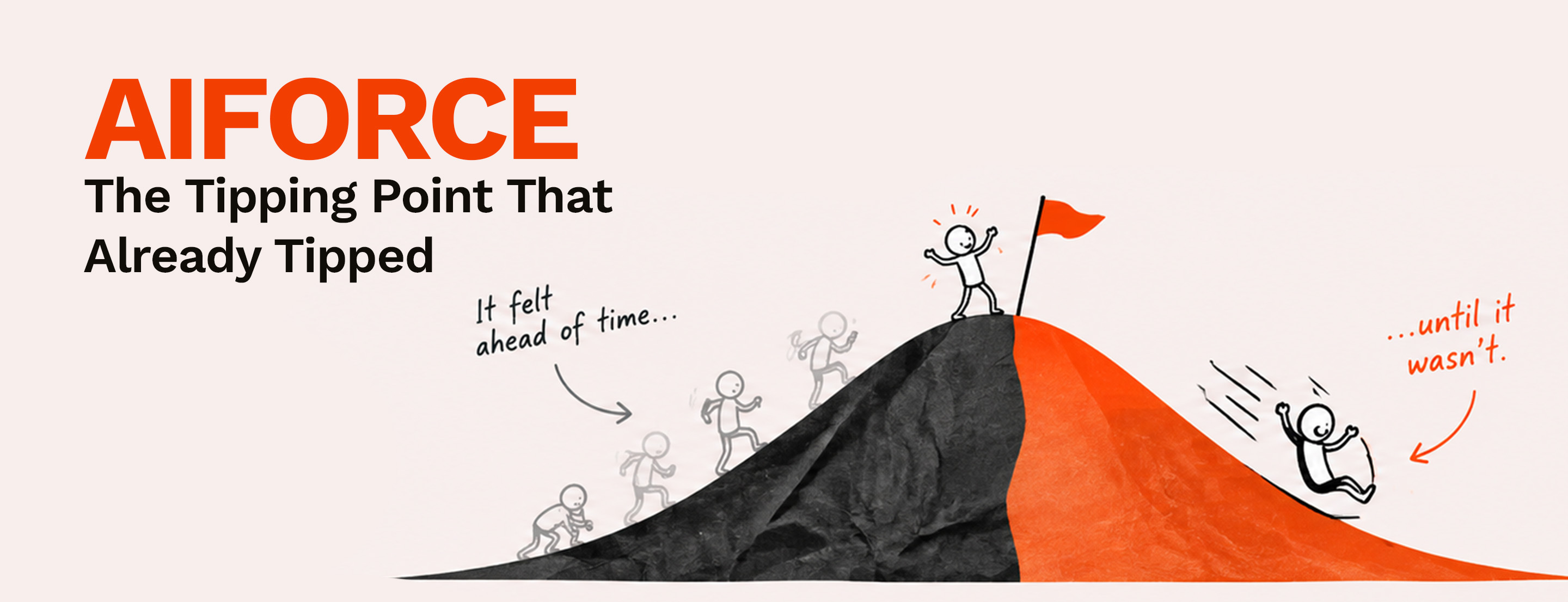
Gladwell called it the Law of the Few. A small number of people carry an idea past the threshold long before the rest of the room notices. What he skipped is the gap that opens next. The few who’ve already moved keep moving. Everyone else keeps planning for the old curve in perfect detail.
That gap is where most firms are living now. AIforce is Salesforce publicly moving to the new curve. 91% of businesses use AI, up from 78% two years ago. The wave already broke while quarterly plans were being written for a slower one.
Every seat inside your firm has already tipped. Just on four different clocks, and nobody sent a memo.
How the tip actually happened here.
Leaders don’t tip on adoption. They tip on belief. Somewhere in the last eighteen months, most senior people stopped seeing AI as something to prepare for and started treating it as the water everything else swims in.
That shift happened on commutes and weekend reads, long before it showed up in a strategy doc. The AIforce demo at Dreamforce was a Salesforce exec building his own command centre inside Claude in eight minutes, without touching Lightning once. That wasn’t a product walkthrough. It was proof of a belief already held.
Three signs it’s happening in your firm:
The firms winning right now closed that gap fast. Messy and moving beats tidy and late.
The check: If your firm’s strategy was written more than six months ago, treat it as history, not plan.
How the tip actually happened here.
Nobody in procurement approved ChatGPT. Nobody signed a contract for Claude on the marketing team. Nobody sanctioned Copilot for developers. All three showed up anyway, through browsers and personal logins, and became essential before anyone thought to ask.
That’s the tip nobody spots. It doesn’t come with a purchase order.
By the time your firm buys an enterprise AI platform, your people have been quietly using AI for months. The rollout isn’t adding a capability. It’s putting a name badge on one:
Firms ahead of this notice what people are already doing and build the official stack on top of the unofficial one. Firms behind wonder why nobody’s excited about the rollout. Because the interesting work already happened without them.
The check: Ask five people on your team what AI tools they use in a normal week. If the list is longer than what your firm officially provides, the tip already ran through your team.
How the tip actually happened here.
The client tip is the quietest one. It never announces itself. It’s a slow shift in what “good” means:
Nothing broke. Clients started using AI in their own work, and their standards moved up with them.
The firms feeling this most are the ones whose clients are further along on AI than they are. Those clients aren’t asking whether you use AI. They’re comparing every interaction with you to what their own AI tools give them, and losing patience with the ones that feel behind.
AIforce is Salesforce admitting that its own customers are being judged this way by their customers. The platform shift is a response, not the cause.
The check: Ask your best client what AI tools they use inside their business. If their setup is sharper than yours, you’re being graded on their curve, not the industry’s.
How the tip actually happened here.
The market tip always shows up in prices before it shows up in headlines:
None of this looked like a “tip” while it was happening. Just a bunch of separate moves. Then AIforce lands, and the pattern connects. Enterprise software is being repriced around a completely different idea of where value sits.
The tip happened when investors, analysts, and buyers all started using the same new mental model without agreeing to. The announcement is that the model is becoming visible. It was already running the market.
The check: Look at the last three vendor decisions your firm made. Would that reasoning survive a board that assumes AI-first is the default?
Enterprise software used to win by being the place you went. Now it wins by being the layer that shows up wherever you already are. Same trust, same data, different geometry.
The firms that saw this early aren’t putting out press releases. They’re just quietly billing more and losing fewer pitches.
So the question worth sitting with this week is:
Which of the four tips has your firm actually adjusted for, and which are you still calling “an interesting trend”?
Everyone will have an answer in twelve months. The useful thing is having one now.

With 20 years across consulting, technology, and leadership, I’ve seen how great work is shaped by both systems and people. Building MIDCAI is my next chapter, where experience meets clarity, and AI, data, CRM, and MarTech come together with a deeply human approach.
Get in touch with us for any enquiries and questions
Define your goals and identify areas where technology can add value to your business
We are looking for passionate people to join us on our mission.
where your skills fuel innovation and your growth powers ours
.jpg)