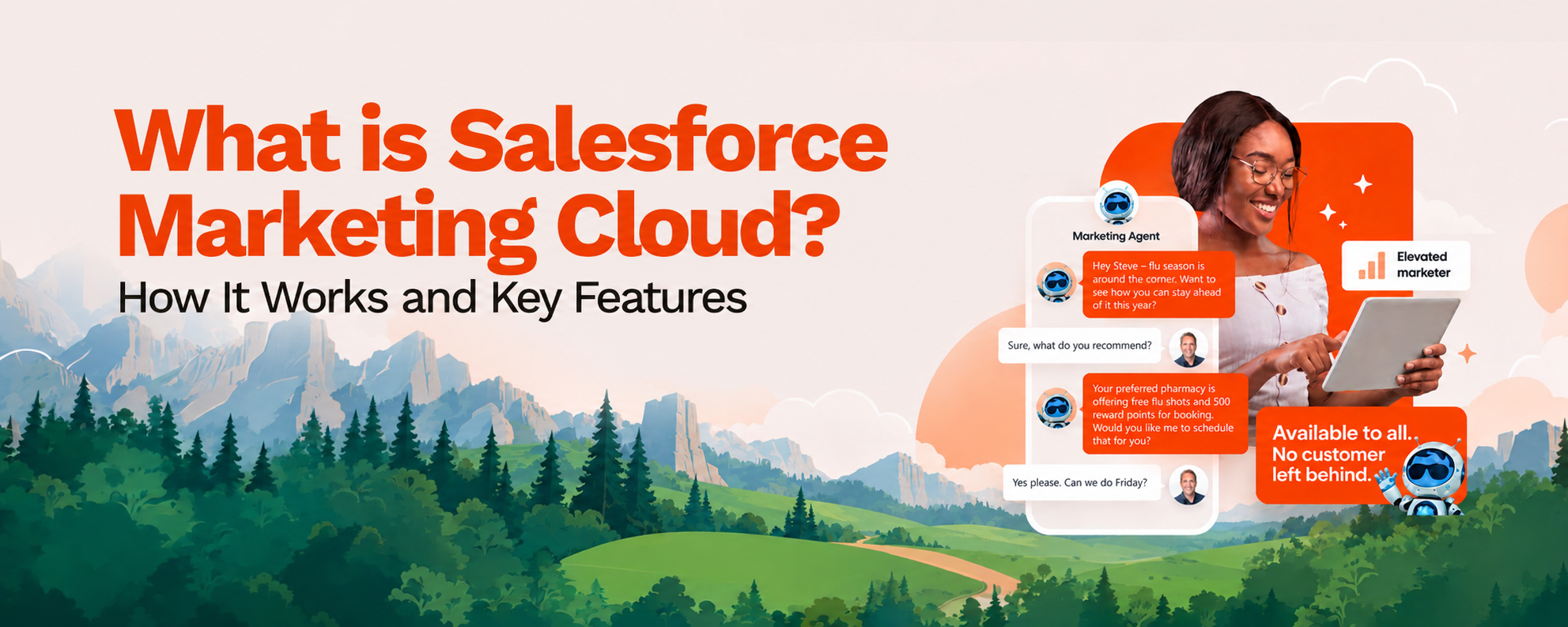


Your emails are automated. Your to-do list apparently didn’t get the memo.
Salesforce Marketing Cloud already helps teams run campaigns and customer journeys. But choosing audiences, preparing content, and adjusting campaigns still takes work.
Agentforce Marketing brings AI agents into those steps. With connected customer data and approved actions, agents can help marketers plan, create, and manage campaigns, not just follow instructions set in advance.
So, what’s actually different, and how much can agents take on?
Here’s what is Salesforce Marketing Cloud, how it works, its key features, and how it compares with traditional marketing automation.
Salesforce Marketing Cloud (now evolving into Agentforce Marketing) is an enterprise digital marketing platform that unifies customer data and automates personalized cross-channel campaigns.
It helps marketers use customer data to build audiences, automate communication, and understand campaign performance.
The suite includes products such as Marketing Cloud Engagement and Account Engagement, alongside offerings such as Marketing Cloud Next. Agentforce Marketing brings AI-agent capabilities into supported marketing workflows. Available tools vary by product and license.
Salesforce Marketing Cloud turns customer information into coordinated campaigns. The tools differ by product, but the process usually looks like this.
Customer information can come from Salesforce CRM, websites, purchases, and other connected sources. Salesforce Data 360 can unify data across systems, giving marketers a clearer view of customer behavior.
Marketers segment customers using attributes, interests, and engagement. They can then prepare emails, offers, and content for each group. In supported Agentforce Marketing workflows, AI agents can help create segments and campaign drafts.
Tools such as Journey Builder let teams define what happens after a signup, click, or purchase. A new subscriber might receive a welcome email, while a returning shopper gets a different follow-up. Journeys can use supported messaging channels.
Marketing Cloud reporting shows which messages people open, click, or ignore. Teams use those signals to improve future campaigns. With Agentforce Marketing, approved AI-agent actions can also support certain tasks through Salesforce Flow and connected tools.
Customer data → audience → journey → results. The technology connects these steps; marketers decide the goals and guardrails.
Salesforce Marketing Cloud helps teams manage everything from customer data and campaign journeys to personalization and performance tracking. Newer Agentforce Marketing capabilities also bring AI agents into parts of this work. Here are eight key features.
Salesforce Marketing Cloud can use Data 360 to bring customer information from CRM, purchases, website activity, and other sources together. Marketers can use this data to build more relevant audiences. With Agentforce, they can also describe the audience they want to reach and get help creating the segment.
Marketing Cloud helps businesses connect with customers across channels such as email, SMS, mobile, web, and WhatsApp, depending on the products they use. Agentforce Marketing can also support two-way conversations, so customers can reply, ask questions, and receive contextual responses.
Marketers can build journeys that respond to customer actions instead of manually managing every follow-up. Journey Builder supports automated journeys in Marketing Cloud Engagement, while Marketing Cloud Next uses Flow to manage next-generation journeys based on customer data and behavior.
Marketing Cloud Next allows teams to create forms and landing pages for lead capture. Businesses can collect customer information, create or update CRM records, and connect form submissions directly to automated follow-up flows.
Salesforce Personalization uses customer behavior and other signals to decide what someone should see next. Businesses can personalize website, app, and email experiences and recommend products, content, or offers based on each customer's interests and activity.
Marketing Cloud helps teams understand how campaigns are performing across channels. Marketers can use dashboards, attribution reporting, and performance data to see what's working, identify weaker campaigns, and understand how marketing activity contributes to business results.
Businesses can use customer audiences from Salesforce across supported advertising channels such as search, social, and display. Agentforce Marketing can also help monitor ad performance, recommend budget changes, and take approved actions when campaigns aren't performing as expected.
Agentforce Marketing can help marketers turn a campaign goal into an actual campaign plan. AI agents can help prepare briefs, suggest audiences and journeys, and create on-brand content for review. Marketers still control what gets approved and launched.
Traditional marketing automation helps teams manage repetitive tasks, such as sending emails, updating customer records, and running campaigns based on predefined rules.
Agentforce Marketing takes this a step further. It uses AI agents to help marketers make decisions and complete tasks using customer data, instructions, and approved actions.
Here’s how the two approaches compare:
The biggest difference is how the work gets done. Traditional automation follows the processes marketers build, while Agentforce Marketing allows AI agents to help manage parts of those processes.
This doesn’t mean traditional marketing automation lacks AI or personalization. Agentforce Marketing builds on existing capabilities by adding agents that can reason about tasks and take action within defined limits.
Salesforce Marketing Cloud helps teams manage campaigns more efficiently, use customer data more effectively, and create more relevant customer experiences across channels. Newer Agentforce Marketing capabilities can extend this by adding AI assistance to supported marketing tasks.
The results depend on the Salesforce products in use, the quality of customer data, and how campaigns, journeys, and AI capabilities are configured.
Salesforce Marketing Cloud doesn't have a single fixed price. Salesforce offers different marketing editions, and the cost depends on the features your business needs and the products you already use.
Here are the starting prices listed by Salesforce:
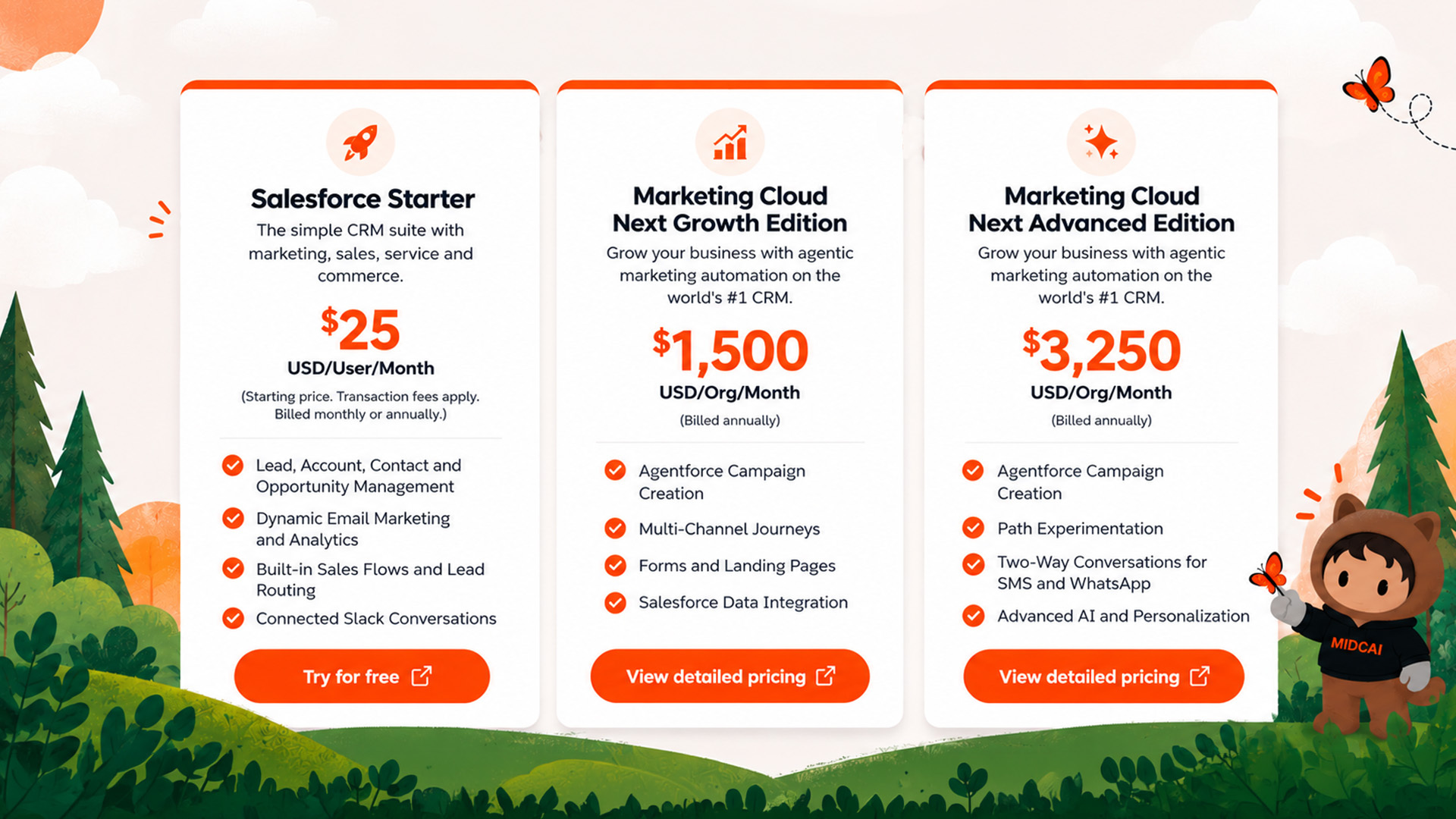
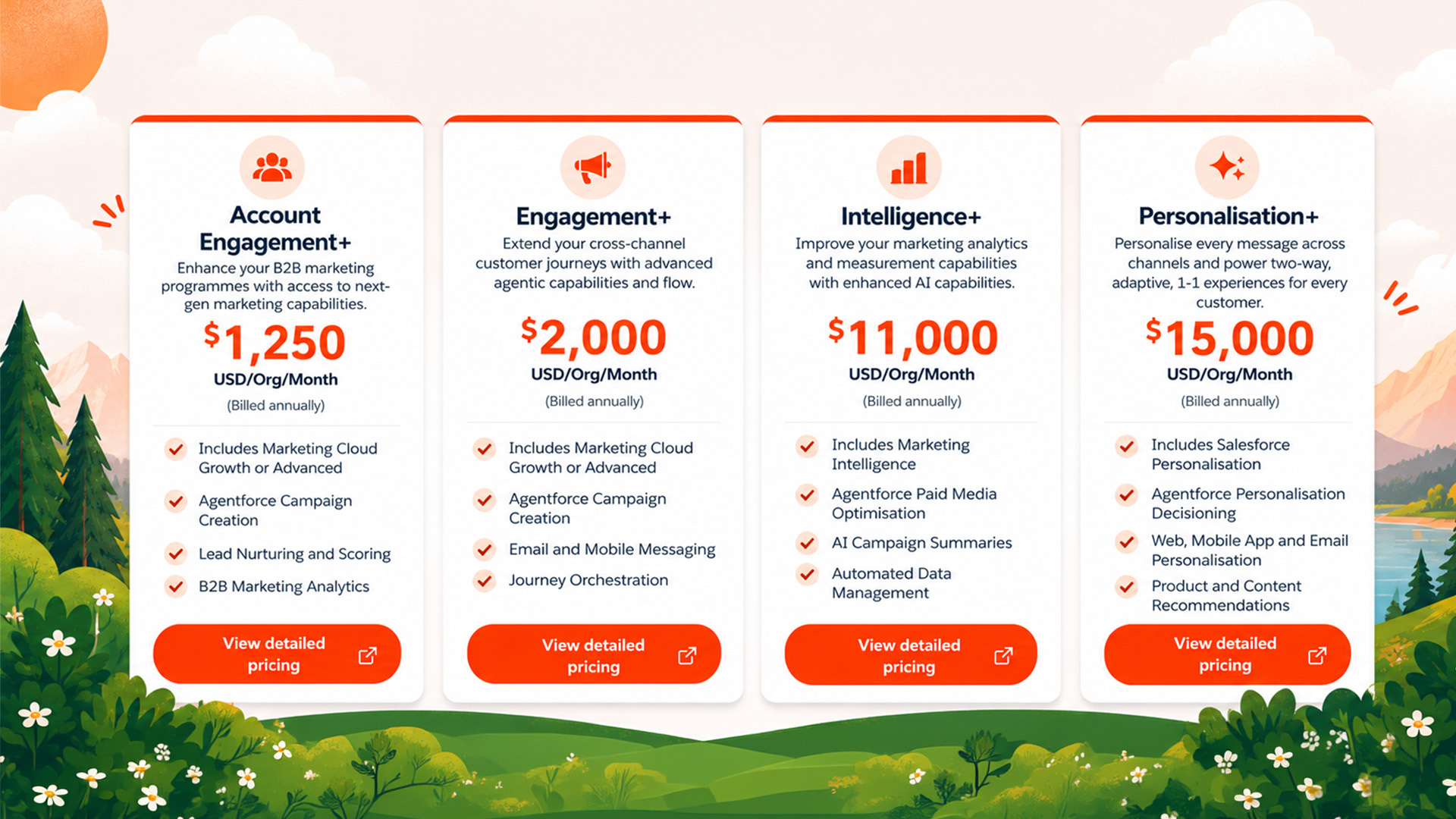
All prices are in USD per organization per month, billed annually.
Yes. Depending on your setup, you may need to budget for additional Data 360 credits, Agentforce usage, SMS and WhatsApp messaging, or other marketing add-ons.
The final cost will depend on your Salesforce edition, the capabilities you enable, and your usage. Businesses already using Marketing Cloud should also check which Agentforce Marketing features are included in their existing licenses before purchasing anything new.
Salesforce Marketing Cloud is worth considering for businesses that need to manage customer data, campaigns, personalization, and engagement across multiple channels.
It may be a good fit for:
Businesses exploring AI-led marketing can also evaluate Agentforce Marketing alongside their Salesforce Marketing Cloud setup to identify where AI agents can support existing workflows.
The biggest mistake with Salesforce Marketing Cloud? Treating it like just another campaign tool.
Its real value comes from what happens when customer data, marketing automation, personalization, and journey orchestration start working together. Add Agentforce Marketing, and AI agents can take on supported marketing tasks without pushing marketers out of the loop.
At MIDCAI, we help businesses connect the dots between Salesforce Marketing Cloud, Data 360, and Agentforce. From Salesforce Marketing Cloud implementation and audience segmentation to customer personalization, automation, and cross-channel orchestration, we help build marketing workflows that actually fit the way your business operates.
You may not need more marketing tools. You may just need your existing ones to work better together.
Ready to make Salesforce Marketing Cloud work harder for your business? Let’s talk.

5+ years of experience in content strategy, marketing, and technical communication. At MIDCAI, I focus on turning ideas around Salesforce, data, and AI into clear, actionable insights that help enterprises attract the right audience and drive real adoption.
Got questions? We’ve got answers. Explore common queries to understand how we work and what to expect.
Salesforce Marketing Cloud helps businesses create campaigns, build audiences, personalize customer experiences, automate journeys, and measure marketing performance. Depending on the products you use, it can support email, SMS, WhatsApp, web personalization, advertising, lead nurturing, and other marketing activities.
Salesforce Marketing Cloud can support customer engagement across channels such as email, SMS, WhatsApp, mobile, web, and paid media, depending on the products and configuration you use. This allows teams to coordinate campaigns across more than one touchpoint instead of managing each channel separately.
Yes. B2C teams can use Salesforce Marketing Cloud for high-volume customer journeys, personalized campaigns, and cross-channel engagement. B2B teams can use it for lead nurturing, account-based marketing, demand generation, and closer coordination between marketing and sales.
Data 360 brings customer information from different sources together into unified profiles. Salesforce Marketing Cloud can use this data for audience segmentation, personalization, journey decisions, and campaign activation, while Agentforce can use the same context to support AI-powered marketing tasks.
Agentforce Marketing adds AI agents that can help marketers with tasks such as creating campaign briefs, building audiences, preparing content, analyzing performance, and taking approved actions. It extends Salesforce Marketing Cloud's existing automation rather than replacing the core marketing tools.
Get in touch with us for any enquiries and questions
Define your goals and identify areas where technology can add value to your business
We are looking for passionate people to join us on our mission.
where your skills fuel innovation and your growth powers ours