

I have often wondered why reaching a goal feels so different from imagining it. We spend months, sometimes years, working towards something. And when we finally get there, we expect a certain feeling, a sense of arrival, perhaps even relief.
But strangely, that feeling doesn't always last. Soon, there is another goal. Another deadline. Another mountain to climb. For a long time, I thought this was simply what ambition looked like.
Then I came across the story of Sisyphus through Camus philosophy.
What an ancient myth and a twentieth-century philosopher can teach us about work, ambition, repetition, and the search for a life that feels meaningful. There is a strange moment that often follows achievement.
You finally get the promotion you worked towards. You complete the project that consumed your evenings. You learn the skill you once struggled with. You reach the position you once imagined would make you feel successful. And then, almost quietly, the satisfaction begins to fade. There is another target. Another responsibility. Another skill to master. Another version of yourself to become.
The finish line simply moves.
We rarely talk about this part of ambition. We talk about the excitement of reaching the top, but not about what happens when we discover that there is another mountain waiting.
Perhaps this is why an ancient Greek myth continues to feel so relevant. It is the story of Sisyphus.
I first encountered the story of Sisyphus as a myth about punishment. But the more I understood it, the more it began to feel like a story about something much closer to everyday life.
Sisyphus was a king in Greek mythology, known for his intelligence, cunning, and repeated attempts to deceive the gods. He even managed to cheat death more than once, refusing to accept the fate that had been decided for him.
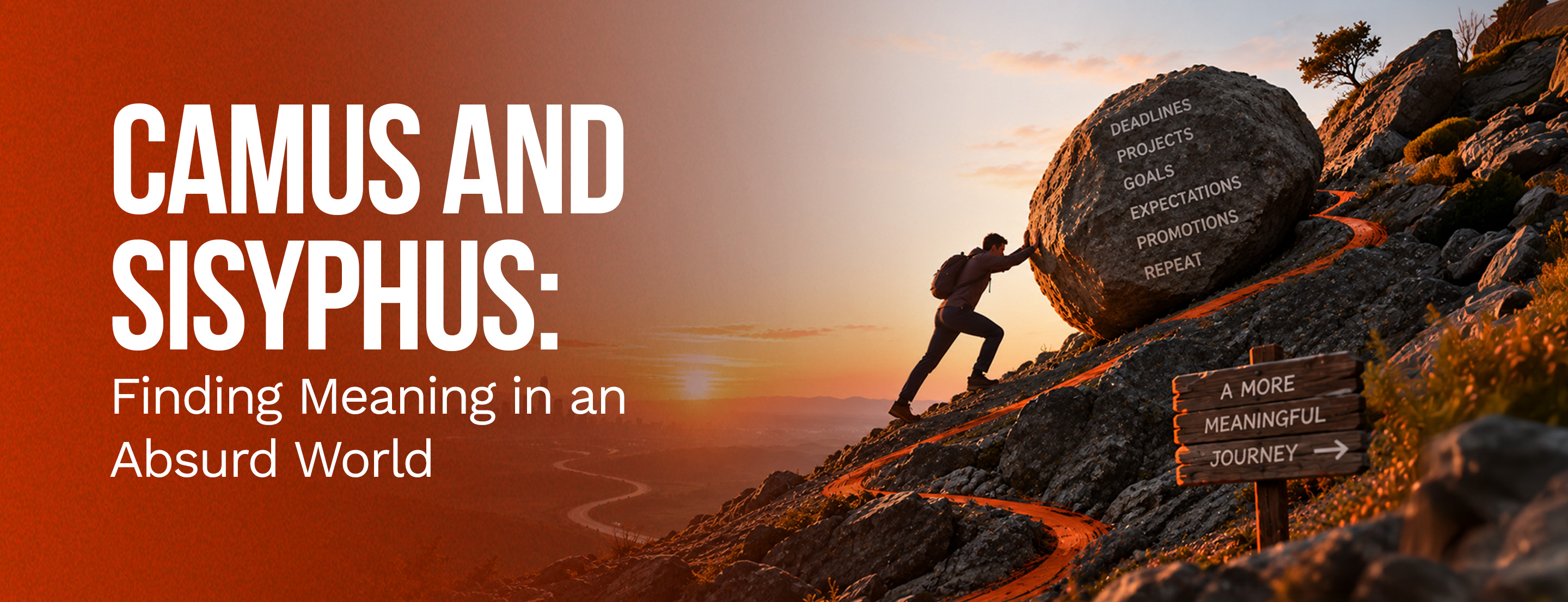
Eventually, the gods had enough. For his defiance, Sisyphus was condemned to an unusual and eternal punishment: he would have to push an enormous boulder up a mountain.
He would struggle against its weight, pushing it higher and higher, until he was almost at the summit. And then, just before he could succeed, the boulder would roll all the way back down. He would have to walk back, retrieve it, and begin again. And again. And again.
There was no final ascent. No moment when the boulder would stay at the top. No completion. No possibility of saying, “I’m done.” His punishment was not simply that the work was difficult. It was that the work could never be finished.
Imagine knowing, with absolute certainty, that everything you accomplish today will have to be done again tomorrow. That was Sisyphus's existence.
And centuries later, French philosopher and writer Albert Camus looked at this seemingly hopeless story and saw something much larger than a punishment.
He saw the human condition.
In his 1942 philosophical essay The Myth of Sisyphus, Camus used the story of Sisyphus to explore what he called the absurd.
The absurd does not simply mean that life is ridiculous or meaningless. It comes from a tension between two things: our deep desire for meaning, order, and purpose, and a world that does not necessarily provide them.
We naturally look for reasons behind what happens to us. We want our struggles to lead somewhere. We want to believe that if we work hard enough, sacrifice enough, or endure enough, there will eventually be a moment when everything falls into place.
But life does not always offer that kind of resolution.
People work hard and still fail. Plans change. Careers take unexpected turns. Relationships end. Achievements that once seemed enormous eventually become ordinary. And after reaching one goal, we often find ourselves standing in front of another.
This is where Camus's idea becomes uncomfortable.
If the world does not come with a guaranteed purpose, what makes our effort worthwhile? Camus rejected the idea that we should simply give up because life has no predetermined meaning. He also rejected the idea of pretending that everything happens for a reason. Instead, he proposed a third possibility: we acknowledge the absurdity and still choose to live, act, create, and engage with life.
Meaning, in this sense, is not necessarily something waiting somewhere for us to discover. It is something we participate in creating. And this brings us back to Sisyphus.
Sisyphus knows exactly what awaits him. He knows the boulder will roll back down. He knows the climb has no final destination. He knows there is no ultimate victory waiting at the summit. Yet Camus ends his essay with one of philosophy's most striking lines:
“One must imagine Sisyphus happy.” Why?
Because perhaps happiness, for Camus, does not depend on changing the circumstances of our lives. Sisyphus cannot change his punishment. What he can change is his relationship with it.
The moment he fully recognises his condition, he is no longer living under the illusion that the next climb will finally bring him freedom. He knows the reality of his existence and still chooses to push.
The victory, then, is not in getting the boulder to the top. It is in refusing to let the boulder determine the meaning of his existence.
And this is where an ancient Greek myth begins to sound surprisingly familiar. Because perhaps our modern boulders are not so different.
Most of us will never push a literal boulder up a mountain. But we know what it feels like to push something that keeps returning.
The project gets completed, and another appears. The quarter ends, and another begins. The inbox gets cleared, and fills again. You solve one problem, and three more arrive. You achieve one professional milestone, only to immediately start thinking about the next.
There is nothing inherently wrong with this. Work requires repetition. Growth requires repetition. Mastery requires repetition. But something changes when we begin to believe that the next achievement will finally make us feel complete.
I'll be happy when I get promoted. I'll feel successful when I reach that position. I'll relax when this project is over. I'll feel confident when I know enough.
And then we arrive, for a moment, there is satisfaction. Then the mind asks: What's next? The boulder has rolled back down.
It would be easy to interpret Sisyphus as an argument against ambition. It isn't. Wanting to grow is not the problem. Wanting a better career is not the problem. Setting ambitious goals is not the problem.
The problem begins when we make the achievement responsible for our sense of meaning. Because achievement is temporary. Titles change. Projects end. Skills become outdated. Goals get replaced. Even success eventually becomes familiar.
If our sense of worth depends entirely on reaching the next summit, we will spend much of our lives living in anticipation of a future version of ourselves. And the present becomes merely a place we pass through. That is the trap.
We become so focused on where we are going that we stop noticing who we are becoming while we get there.
Repetition can look like stagnation from the outside. Another project. Another deadline. Another difficult conversation. Another problem that looks remarkably similar to the one you solved last month. But repetition is also how expertise is built.
A leader handles another difficult conversation and becomes better at reading people. A writer writes another article and develops a sharper voice. A designer revises another idea and learns to recognise what works. A consultant solves another problem and begins to see patterns others might miss.
The task may resemble yesterday's task. But the person doing it doesn't have to be the same. Experience develops judgement. Failure develops resilience. Practice develops fluency. Reflection develops perspective.
This is where Sisyphus's journey offers another interesting metaphor.
After the boulder rolls back down the mountain, he has to walk down and begin again. That walk back may appear to be nothing more than the space between two identical attempts. But in our professional lives, the space between attempts can be where the real growth happens.
We often move too quickly from one challenge to the next.
A project ends, and another begins. A deadline is met, and another appears. A quarter closes, and we immediately start preparing for the next one. We keep pushing, but rarely stop to examine the climb.
What did I learn? What became easier? Where did I struggle? What would I do differently? What did this experience reveal about the way I work?
Without reflection, repetition can become a cycle. With reflection, repetition becomes growth.
The mountain may look exactly the same. The boulder may be just as heavy. But if every climb leaves us with greater skill, deeper judgement, and a better understanding of ourselves, then the repetition is not meaningless.
The work may repeat. The climb may repeat. But we don't have to remain the same person who started it.
Maybe that is what makes the story of Sisyphus so uncomfortable and so relevant. We spend much of our lives believing that the next summit will be different. But there is always another boulder. Another mountain.
Another version of “enough.”
Camus's Sisyphus offers a different way of looking at the climb. He does not find meaning because the boulder eventually stays at the top. It never does. He finds meaning by confronting the reality of his situation and still choosing to engage with it.
Perhaps our lives are not so different.
We cannot control every mountain we are asked to climb. We cannot make every effort produce the outcome we want. We cannot guarantee that the next achievement will bring lasting satisfaction.
But we can decide what the climb means to us.
We can learn from it. We can become better at it. We can notice who we are becoming along the way. And sometimes, we can simply allow ourselves to appreciate how far we have already climbed. Because perhaps success is not the moment when the boulder finally stops rolling.
Perhaps it is learning not to postpone our sense of meaning until it does.
The mountain may remain. The work may begin again tomorrow. The finish line may keep moving. But we don't have to.
We can keep moving forward without constantly believing that our life will finally begin when we reach the next summit. And perhaps that is what Camus meant when he asked us to imagine Sisyphus happy, not because his struggle disappeared, but because he found a way to live fully within it.

Currently working as a QA Intern at MIDCAI, I’m learning the ropes of software testing, understanding project workflows, and growing through hands-on experience in a fast-paced environment. Beyond tech, I’m deeply interested in writing, workplace dynamics, and exploring the realities of office culture through observations and conversations.
Get in touch with us for any enquiries and questions
Define your goals and identify areas where technology can add value to your business
We are looking for passionate people to join us on our mission.
where your skills fuel innovation and your growth powers ours

.jpg)