

A person can be labelled in a sentence and misunderstood for years.
At work, we are constantly observing one another. We notice who speaks confidently in meetings, who hesitates, who asks too many questions, who takes longer to learn, who avoids confrontation, who becomes emotional under pressure.
We call these things personality traits. Sometimes, we call them weaknesses.
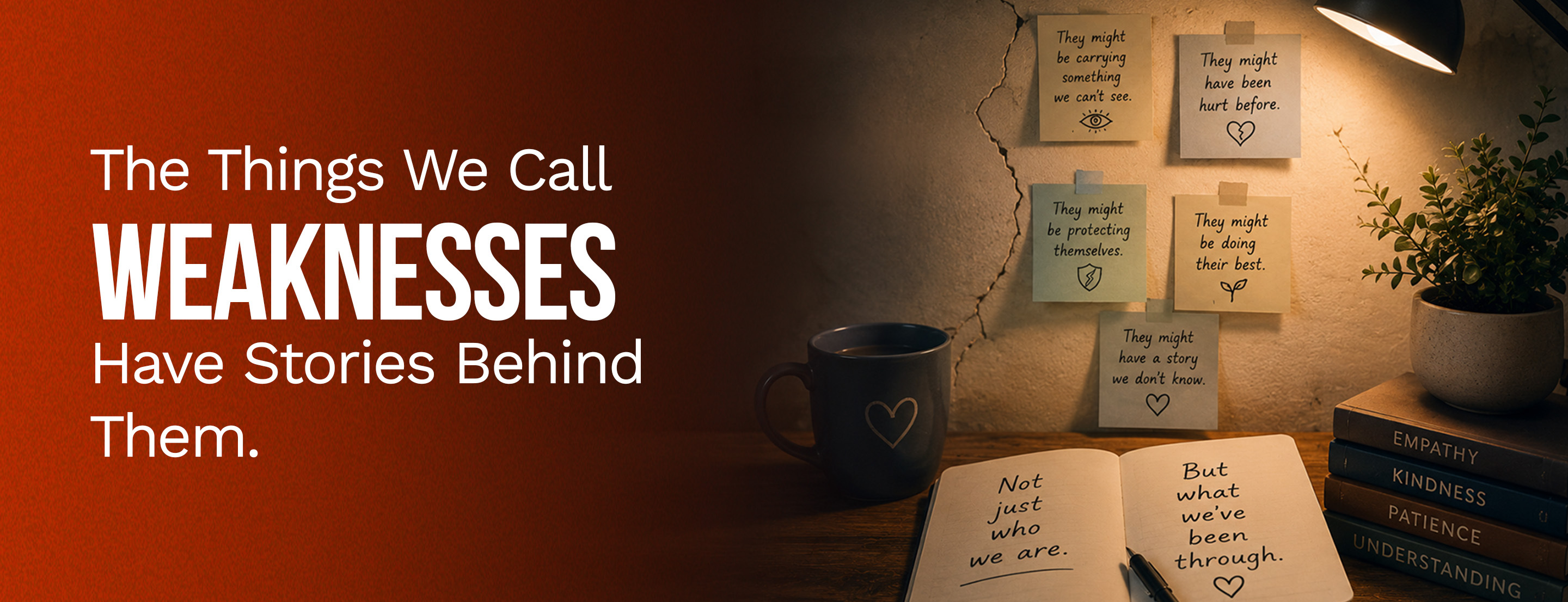
But human behaviour rarely begins where we first notice it. The hesitation may have a history. The silence may have a reason. The caution may have been learned. The insecurity may have once been protection.
What we see in a colleague today may be the visible result of experiences we know nothing about.
And perhaps this is one of the places where empathy becomes particularly important at work, not because it asks us to excuse behaviour, but because it asks us to question our certainty about the person behind it.
Every workplace is filled with visible behaviour and invisible context. We see how quickly someone responds, how often they speak in meetings, how confidently they present an idea, how they react to feedback, or how they handle pressure.
What we don't necessarily see is what shaped those behaviours.
Someone who hesitates before speaking may not lack confidence. They may simply think carefully before expressing themselves.
Someone who repeatedly seeks clarification may not lack competence. They may have learned that making mistakes comes with a significant cost.
Someone who avoids disagreement may not lack courage. They may have spent years in environments where conflict felt unsafe or unproductive.
Someone who becomes emotional during difficult conversations may not be incapable of handling pressure. They may simply experience situations more deeply than others do.
None of this means that every behaviour should be excused. It means something more important:
We should be careful about confusing an observation with an explanation.
Seeing that someone is quiet is an observation. Deciding that they are uninterested is an interpretation. Those are two very different things.
Every organisation develops, consciously or unconsciously, an idea of what a successful employee looks like. Confident. Articulate. Fast. Decisive. Assertive. Adaptable. Proactive.
These are valuable qualities. But problems arise when they become the only acceptable way of demonstrating capability.
Consider confidence. We often associate confidence with speaking quickly, expressing opinions freely, taking charge of a conversation, or being comfortable in the spotlight. But confidence can also look like listening carefully, asking a thoughtful question, admitting that you don't know something, or taking the time to understand before making a decision.
The same applies to leadership. Some people lead from the front. Others lead through consistency, observation, expertise, and the ability to create space for others.
A workplace that recognises only one version of confidence, leadership, or communication risks turning personality differences into performance judgements. And that can have consequences far beyond individual perception.
When people repeatedly hear that they are “too quiet,” “too slow,” “too sensitive,” or “not confident enough,” they may eventually stop seeing these as behaviours they can develop and start seeing them as flaws in who they are.
Labels do more than describe behaviour. When repeated often enough, they can begin to shape the way a person sees themselves.
Tell someone often enough that they are slow, and they may eventually approach new tasks with the assumption that they will struggle.
Tell someone they are not confident, and they may become increasingly conscious of every word before they speak.
Call someone too emotional, and they may begin questioning whether their feelings are valid at all, rather than learning how to understand and regulate them.
This is how an external judgement can quietly become an internal belief.
The pattern is subtle, but powerful:
A behaviour is noticed.
↓
The behaviour is given a label.
↓
The label shapes self-perception.
↓
Self-perception influences future behaviour.
↓
That behaviour then appears to validate the original label.
What began as someone else's observation can eventually become part of a person's identity.
And this is why workplace feedback carries more weight than we sometimes realise.
A manager may forget an offhand comment within minutes. A colleague may not even remember saying it. But the person who heard it may carry those words into their next meeting, their next presentation, or their next opportunity to try.
Feedback can help someone grow, but careless labels can teach someone to shrink.
The responsibility, therefore, is not to avoid difficult feedback. It is to be thoughtful about the difference between addressing a behaviour and defining a person by it.
There is, however, an important distinction to make. Understanding someone's story does not mean removing responsibility for their behaviour. A difficult past does not make harmful behaviour acceptable. A lack of confidence does not mean someone should never be challenged. Taking longer to learn does not mean performance expectations should disappear.
Empathy should not lower standards. It should improve the way we help people reach them.
There is a difference between telling someone, “You need to be more confident,” and helping them understand where their hesitation comes from and what might help them participate more effectively.
There is a difference between labelling someone as “slow” and asking whether they need clarity, practice, guidance, or simply a little more time to build familiarity.
Accountability asks: “What needs to change?”
Empathy asks: “What might be getting in the way?”
A healthy workplace needs both.
We often think empathy means understanding what someone is going through. But sometimes, empathy begins much earlier. It begins with recognising that we may not know the whole story.
At work, we are constantly interpreting other people's behaviour. Someone is unusually quiet. Someone reacts defensively to feedback. Someone needs repeated explanations. Someone doesn't volunteer for new responsibilities. Someone challenges almost every decision.
Our minds naturally fill in the gaps. She's not interested. He's not capable. She's difficult. Etc
And once we believe our interpretation, we stop looking for anything beyond it. Perhaps becoming more empathetic requires us to interrupt that instinct. Not by making excuses for people. Not by assuming we know what they have been through. But by becoming more curious before becoming certain.
Instead of “She's not interested,” we might think: “I've noticed she's been quieter lately. I wonder if something has changed.”
Instead of “He's not capable,”: “He's struggling with this. What might help him understand it better?”
The difference may seem small, but it changes everything. Judgement closes the conversation. Curiosity keeps it open. And curiosity is often where empathy begins. Because when we stop assuming, we create space to listen. When we listen, we understand. When we understand, we respond differently.
And perhaps that is what becoming a better human being really looks like, not becoming someone who never judges, never gets frustrated, or always understands everyone perfectly. It is learning to pause between what we see and what we conclude. To remember that the person in front of us is more than the behaviour we happen to witness. That their silence may have a history. Their hesitation may have a reason. Their defensiveness may have a wound behind it. Their struggle may be temporary. And our interpretation may simply be incomplete.
Empathy is not about knowing everyone's story. It is about leaving enough room for the possibility that there is one. That is the kind of empathy workplaces need. And perhaps, more importantly, the kind of empathy we need to become better human beings.
Perhaps the greatest lesson here extends beyond the workplace. Because this is not only about how we treat colleagues. It is about how we look at people.
We live in a world that encourages quick conclusions. We form impressions within seconds, attach labels to behaviours, and often mistake what we see for what is true. But people are rarely that simple. There may be more behind their behaviour than we will ever know.
And perhaps we don't need to know every story. We simply need to remember that we are looking at a person, not a label.
We can hold people accountable without reducing them to their mistakes. We can expect growth without making someone feel defined by where they currently struggle. And we can become more empathetic without pretending to understand experiences we have never lived. Maybe being a better colleague and ultimately, a better human being is not about learning to understand everyone perfectly.
Perhaps it is about developing the humility to say: “I don't know the whole story.”
That one thought can change the way we speak. The way we give feedback. The way we lead. The way we listen. And perhaps even the way we see ourselves.
Because behind every behaviour is a context. Behind every label is a person. And behind every person is a story we may never fully know.
So before we call something a weakness, perhaps we should pause long enough to ask what story lies behind it. That pause may be small. But sometimes, empathy begins there.

Currently working as a QA Intern at MIDCAI, I’m learning the ropes of software testing, understanding project workflows, and growing through hands-on experience in a fast-paced environment. Beyond tech, I’m deeply interested in writing, workplace dynamics, and exploring the realities of office culture through observations and conversations.
Get in touch with us for any enquiries and questions
Define your goals and identify areas where technology can add value to your business
We are looking for passionate people to join us on our mission.
where your skills fuel innovation and your growth powers ours

.jpg)