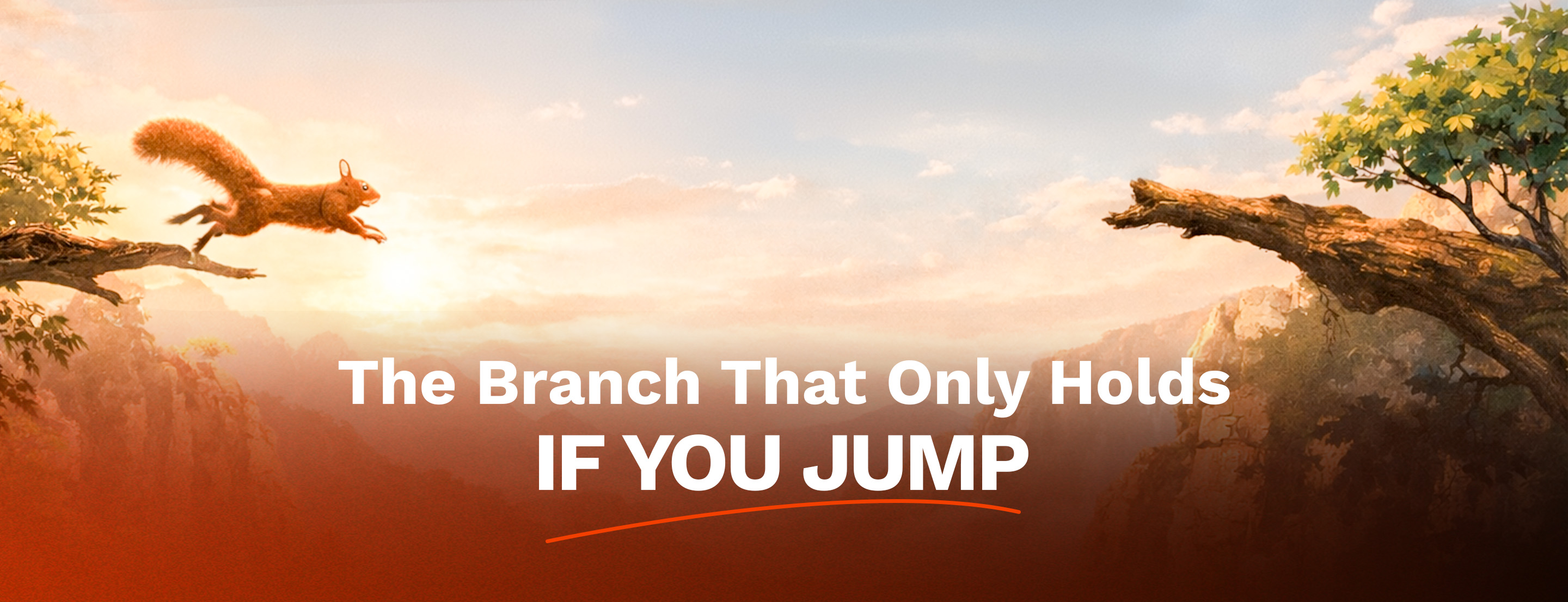


Last week, I was driving to work when I saw something that felt oddly familiar. A squirrel stood at the edge of the road. It wanted to cross. You could tell. It took one step forward. Paused. It looked left and then right. It took another step. Suddenly panicked and ran back. Then forward again. Then froze.
Cars slowed down. One driver waved it across. Another honked lightly. The squirrel kept recalculating its move like a tiny risk analyst in a fur coat. And at that moment, I laughed, not at the squirrel. At myself.
Because that squirrel? That is my brain on most days.
Constantly assessing. Constantly calculating. Constantly preparing for what might go wrong.
Have you ever noticed how exhausting it is to stand at the edge of a decision, wanting to move, but unable to commit? How much energy do we spend going back and forth, forward and backward, convincing ourselves we’re being “careful”, when we’re actually just afraid?
Maybe the real question isn’t whether the road is safe. Maybe the real question is: How long will we keep standing at the edge?
Let’s dive a little into this article to know more about the overthinking squirrel that lives inside us or has stayed inside us at some point of time.
If overthinking were a competitive sport, many of us wouldn’t just qualify for nationals but we would demand video replays, performance analytics, and a post-match self-review.
We don’t just think. We scenario-plan. We consequence-map. We mentally rehearse conversations that haven’t happened yet. We run simulations of outcomes that may never exist. Before taking one simple step, our mind opens twenty tabs:
What if I fail? What if I embarrass myself? What if I’m not ready? What will people think? What if this changes everything? What if this doesn’t change anything at all? And so on and on and on…
It sounds responsible. It feels intelligent. It even looks mature from the outside. But inside?
It’s exhausting.
My brain has this fascinating ability to sprint miles ahead of me. It builds worst-case presentations before I’ve even clicked “Apply.” It drafts imaginary criticism before I’ve even spoken in the meeting. It predicts disappointment before I’ve even tried.
There were phases in my career when this constant internal analysis made me almost incapable of making decisions. Also in my personal life too.
Not because I lacked clarity. Not because I lacked ambition. Not because opportunities weren’t there. But because I had too much imagination. You start believing you’re being careful when in reality, you’re just being afraid in a very sophisticated way.
The mind says, “Let’s think about this a little more.” And “a little more” quietly turns into months. Overthinking doesn’t scream. It whispers. And that whisper sounds surprisingly intelligent.
Here’s what I’ve learned, not from a leadership book, not from a workshop but from that overthinking squirrel at the roadside.
Some opportunities in our lives are like branches extending out from a tree.
The trunk is your current role. Your known identity. Your existing skill set. Your comfort zone.
It’s stable. Predictable. Safe.
You can stand on the trunk forever and technically be fine. But growth rarely happens on the trunk. Growth waits on the branch.And here’s the uncomfortable part, the branch only reveals its strength after you put weight on it.
Not before!
That roadside squirrel proved it to me.
In a few sharp seconds just after overthinking, finally it was across. The traffic hadn’t disappeared. The road hadn’t transformed. The world hadn’t paused for it. What changed was not the environment. It was the decision. That’s how branches work too.
You cannot audit a branch endlessly from a distance. You cannot create a spreadsheet that eliminates uncertainty. You cannot consume enough LinkedIn wisdom to feel completely ready.
Standing still feels intelligent. It feels strategic. It feels responsible. But at some point, hesitation stops being wisdom and starts becoming avoidance. The squirrel wasn’t unsafe. The road didn’t suddenly become risk-free. It simply decided that moving forward decisively was safer than staying stuck in the middle.
And that’s what we often miss. The branch doesn’t hold because you analyzed it well. From the trunk, every branch looks fragile. From the branch, you realize it was built to carry more than you thought. The real risk isn’t that the branch will break. The real risk is spending your entire life on the trunk, convincing yourself you’re being wise while secretly knowing you’re just afraid to jump.
There was a time when I delayed decisions simply because I wanted to be 100% certain. My mind would simulate every possible outcome. Ironically, the more I thought, the less I moved. Overthinking feels productive. It feels responsible. It feels mature. But often, it is just fear negotiating for comfort.
And comfort is a brilliant storyteller. It will give you 25 logical reasons to stay where you are. Just like this my mind would simulate every possible outcome, best case, worst case, socially awkward case, career-ending case and so on. I would imagine reactions, rehearse conversations, predict objections, draft mental apologies for things that hadn’t even happened.
And while I was busy optimizing the future, the present was quietly slipping by.
What I didn’t realize then was this: I wasn’t protecting myself from failure. I was protecting myself from discomfort. And discomfort is not danger. It is often just growth knocking in an unfamiliar tone.
In professional life; especially in fast-moving startup ecosystems, hesitation is expensive.
When we delay:
We think we are “being careful.” But often, we are being cautious with our potential. In consulting environments, particularly in tech spaces like Salesforce implementations or dynamic products such as Salesforce Marketing Cloud, nobody ever feels fully ready. You learn while doing. You lead while figuring it out. You build clarity mid-action.
The people who grow fastest are rarely the ones who eliminate fear. They are the ones who move despite it.
And the real mental cost of hesitation?
It slowly trains your brain to believe you are incapable even when you are not.
This is the part most blogs oversimplify. They say, “Just take action,” as if action is a switch you can flip.
What has actually helped me is far less dramatic and far more practical: I reduce the decision window so my mind doesn’t get unlimited time to create fear. Sometimes 48 hours is enough.
I consciously separate real risk from ego by asking myself whether this is truly dangerous or I’m just afraid of how I’ll look. I choose to move before I feel ready because confidence has never been my starting point, it has always been the reward for action and most importantly, I accept that imperfect outcomes are still better than perfect hesitation.
Not every branch will be strong, but stagnation weakens you far more than failure ever will. You don’t need guarantees but you need momentum.
At some point, every one of us becomes that squirrel at the roadside, heart racing, mind calculating, standing inches away from movement yet miles away from decision. The road doesn’t clear completely. The branch doesn’t send a strength certificate. Life rarely pauses to remove uncertainty. What changes everything is not the environment but it is the commitment.
Overthinking builds traffic in the mind; courage creates a lane through it. And the longer we stand on the trunk, convincing ourselves we are being wise, the heavier regret quietly becomes. So if there’s a branch in front of you right now like a role, a risk, a conversation, a version of yourself then remember this: balance is found mid-air, not in rehearsal. The road won’t be perfect. The branch won’t feel guaranteed. But growth has always belonged to those who run, not to those who recalculate forever.

Working as Manager – People and Admin in a dynamic environment at MIDCAI, I’m passionate about creating people-first processes, building purposeful teams, and driving operational efficiency. I thrive on meaningful collaboration and continuous learning. Whether it’s supporting team growth, creating systems that empower people, or adapting to a rapidly evolving tech landscape, I bring heart and hustle to every challenge.
Get in touch with us for any enquiries and questions
Define your goals and identify areas where technology can add value to your business
We are looking for passionate people to join us on our mission.
where your skills fuel innovation and your growth powers ours