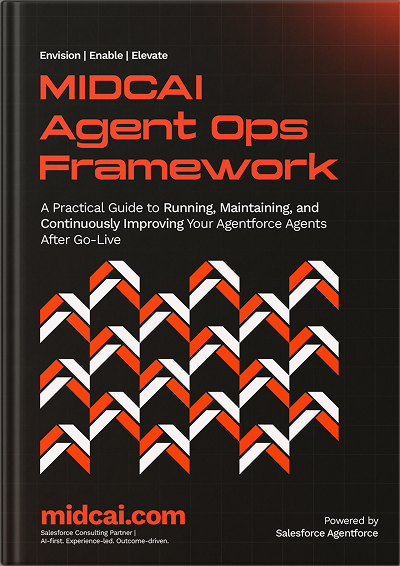
A Practical Guide to Running, Maintaining, and Continuously Improving Your Agentforce Agents After Go-Live
Once published, focus on marketing strategies to promote your eBook. Utilize social media, email marketing, and book promotion sites to reach your audience effectively.
This guide shows how leading teams move from pilot chaos to production stability with Salesforce Agentforce.
A structured approach from experiments to reliable systems
What to track, where agents fail, and how to fix issues early
Turn agent data into ongoing performance gains
Set guardrails to keep agents consistent and aligned
Identify when your AI starts degrading, before your team notices.
Move from one agent to a scalable ecosystem

We’re building the operating layer for Agentforce. Learn how enterprise teams run, govern, and scale Agentforce agents in real production environments without breaking performance, trust, or ROI.


Got questions? We’ve got answers. Explore common queries to understand how we work and what to expect.

No. The frameworks and best practices apply to any CRM setup. Salesforce users will get the most out of the live demo sections, but the concepts are universal.
You can reach our customer support team via email at support@example.com or by calling us at (123) 456-7890. Our support hours are Monday to Friday, 9 AM to 5 PM.
For non-urgent inquiries, please send us an email, and we will respond within 24 hours.
If you need immediate assistance, feel free to call us during our business hours.
Legacy system integration requires a different approach than connecting modern cloud platforms. Most legacy systems were not designed with open APIs or standard data formats, so integration must work around existing constraints rather than against them.
MIDCAI's approach extends legacy system capability through secure connectors, structured file exchanges, or wrapper APIs that expose legacy functionality to modern platforms without requiring changes to the core system that would risk operational stability. The goal is controlled modernization: gaining interoperability with newer platforms while preserving the reliability of systems that core business processes still depend on.